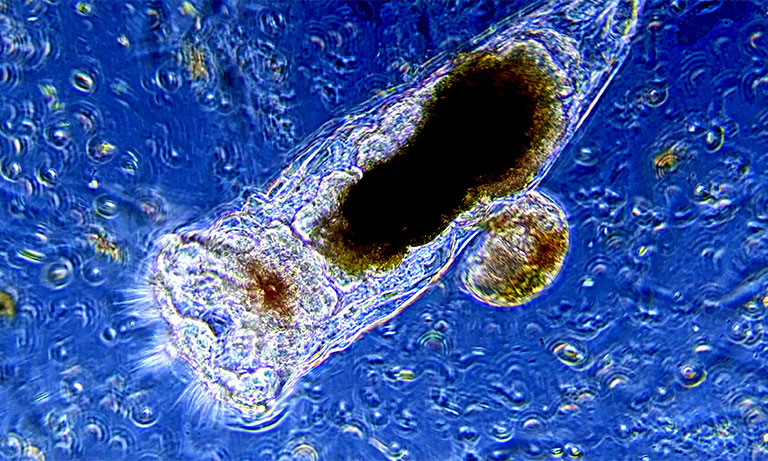
What is a Philodina Rotifer?
Rotifers amongst the smallest members of the Metazoa — that group of multicellular animals whose bodies are organized into systems of organs. Most rotifers are about 0.5mm in length or less, their bodies comprised of a total of around a thousand cells. Their bodies carry out essential functions like digestion and movement, but with simpler organ systems than higher animals.
Taxonomy and Classification
Philodina rotifers belong to the class Bdelloidea within the phylum Rotifera. The phylum Rotifera encompasses a diverse group of microscopic animals characterized by a ciliated corona, a wheel-like structure used for feeding and locomotion. Within the class Bdelloidea, the genus Philodina is one of the most well-known and studied.
The full taxonomy for Philodina is:
- Kingdom: Animalia (animals)
- Phylum: Rotifera (rotifers)
- Class: Eurotatoria
- Subclass: Bdelloidea (bdelloid rotifers)
- Order: Philodinida (may vary depending on classification system)
- Family: Philodinidae Genus: Philodina
Breakdown of each level:
- Kingdom: The broadest classification level, grouping animals together.
- Phylum: A group of related animals with similar characteristics.
- Class: A further division within a phylum, based on more specific features.
- Subclass: A subdivision within a class, indicating a closer relationship between certain groups within the class.
- Order: (may vary depending on classification system) Some systems further classify Bdelloidea into orders, with Philodinida being a possible order that Philodina belongs to.
- Family: A group of closely related genera.
- Genus: A group of species that share a recent common ancestor and similar characteristics.
- Species: The most specific level, referring to a group of organisms that can interbreed and produce fertile offspring.
Morphology and Anatomy
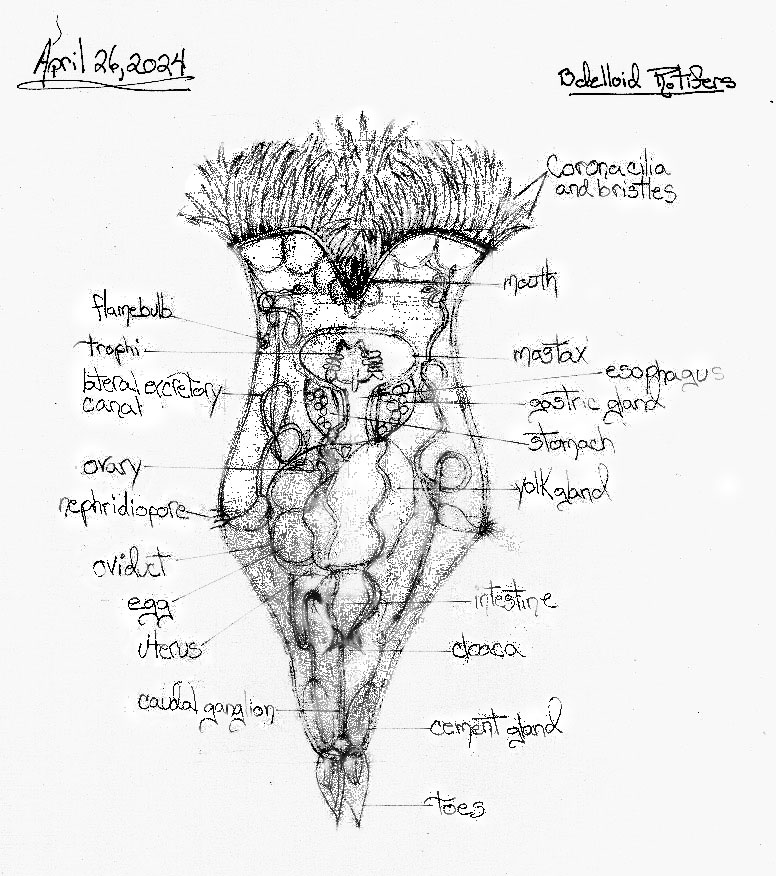
A typical rotifer might have a brain of perhaps fifteen cells with associated nerves and ganglia, a stomach of much the same number, an excretory system of only a dozen or so cells, and a similarly fundamental reproductive system. They have no circulatory system, just a network of canals that help circulate fluids within the body. The bodies of Philodina rotifers, composed of approximately a thousand cells, are cylindrical in shape, typically ranging from 100 to 600 micrometers in length. Their organ systems, though simplified compared to higher animals, perform vital functions within their tiny bodies.
Habitat and Ecology
Philodina rotifers inhabit a wide range of freshwater environments, including ponds, lakes, rivers, and even temporary water bodies such as puddles. They play crucial roles in aquatic ecosystems as primary consumers, feeding on bacteria, algae, and other organic matter. Additionally, Philodina rotifers serve as prey for various aquatic predators, contributing to the intricate web of trophic interactions within their habitats.
Reproduction and Life Cycle
Philodina rotifers, interestingly, have an all-female lineage and reproduce through both sexual and asexual means. Since there are no males in this species, under favorable conditions, they reproduce asexually through parthenogenesis, producing genetically identical offspring. However, they can also reproduce sexually. In this case, females produce unfertilized eggs that develop into dormant resting eggs, capable of withstanding adverse environmental conditions. This reproductive flexibility enables Philodina rotifers to thrive in diverse and unpredictable aquatic habitats.
Bdelloid rotifers – 80 million years without sex
Based on Ed Yong’s article in the National Geographic Bdelloid rotifers, small invertebrates, have defied the evolutionary norm by surviving without sex for some 80 million years. Unlike many animals capable of occasional asexual reproduction, bdelloid rotifers exclusively reproduce asexually, spawning genetically identical clone daughters in an all-female world. This unique reproductive strategy challenges traditional evolutionary theories, as sex typically promotes genetic diversity crucial for adaptation. However, recent research led by Natalia Pouchkina-Stantcheva and Alan Tunnacliffe from the University of Cambridge sheds light on bdelloids’ success. By decoupling the fates of gene copies, bdelloids evolve in new directions, acquiring two genes’ worth of diversity from each pair. Unlike sexually reproducing organisms, bdelloids’ daughters inherit both gene copies from their mothers, allowing for independent evolution. This genetic freedom enables bdelloids to adapt to challenges, evidenced by their diverse species thriving in freshwater environments. This unique approach, akin to gene duplication, demonstrates that bdelloids have thrived despite abandoning sexual reproduction, showcasing nature’s diverse strategies for survival and evolution.
Behavioral Ecology
The feeding behavior of Philodina rotifers involves the use of their corona to create feeding currents, capturing suspended particles and microorganisms from the water column. They exhibit various locomotion patterns, including swimming and crawling, allowing them to navigate through their aquatic environment in search of food and suitable habitat conditions. Additionally, Philodina rotifers may display social behaviors, such as aggregating in response to environmental cues or interacting with conspecifics during mating (even though in this species, mating involves females producing unfertilized eggs for sexual reproduction). This reproductive flexibility enables Philodina rotifers to thrive in diverse and unpredictable aquatic habitats.
Physiological Adaptations
Philodina rotifers possess several physiological adaptations that enable them to survive in challenging environmental conditions. One notable adaptation is their ability to withstand desiccation, allowing them to survive in temporary water bodies that may dry out periodically. They achieve desiccation tolerance through mechanisms such as the synthesis of protective proteins and the formation of dormant resting stages.
Arctic Rotifer Lives after 24,000 Years in a Frozen State
Based on this study scientists at the Soil Cryology Laboratory at the Institute of Physicochemical and Biological Problems in Soil Science in Pushchino, Russia have proven that Arctic rotifers can be revived after being frozen in the Siberian permafrost for 24,000 years.
The main talking points of this study are:
- Multicellular Survival: Bdelloid rotifers, microscopic multicellular organisms, can survive being frozen for at least **24,000 years**.
- Cryptobiosis: They enter a state of cryptobiosis, where metabolism nearly stops, allowing them to endure extreme conditions.
- Research Significance: This discovery by the Soil Cryology Laboratory in Russia represents a significant leap from single-celled organisms to more complex ones with guts and brains.
- Future Implications: Insights from these rotifers could advance cryo-preservation techniques for cells, tissues, and organs of other animals, including humans.
Philodina does not have a Circulatory System
The Philodina rotifer compensates for not having a circulatory system by being very small and having a relatively simple body plan with only around 1,000 cells. This small size allows essential materials like oxygen, nutrients, and waste products to diffuse directly between cells without needing a complex transport system.
While diffusion plays a role in transporting materials within Philodina rotifers due to their small size, it’s not the only mechanism for waste removal. They have a dedicated excretory system, likely consisting of only a dozen or so cells, that helps eliminate waste products. This system collects waste materials from within the rotifer and excretes them through specific openings.
These specific openings through which waste materials are excreted in Philodina rotifers are known as the excretory pores or nephridiopores. These openings are part of the excretory system, which is responsible for removing waste products from the body of the rotifer. The excretory system of Philodina rotifers likely consists of specialized cells called flame cells or protonephridia. Flame cells are multicellular structures found in many freshwater invertebrates, including rotifers. These cells possess specialized cilia that create a beating motion, propelling waste fluids through tubules and eventually out of the body through the excretory pores. The process begins with waste materials being collected from within the body cavity of the rotifer by the flame cells. These cells then transport the waste fluids through a network of tubules, where filtration and concentration may occur. Finally, the waste products are expelled through the excretory pores, effectively removing them from the rotifer’s body and maintaining internal homeostasis. By utilizing specialized openings and cellular structures, Philodina rotifers can efficiently eliminate waste products, ensuring the proper functioning of their internal environment despite their small size and lack of a circulatory system.
The digestive system also plays a role. As Philodina feed, waste products are generated during the breakdown of food in the stomach. These waste products are likely eliminated through the digestive tract and out of the rotifer’s body.
So, Philodina rotifers utilize a combination of diffusion for some exchange and a dedicated excretory system, along with the digestive system, for waste removal.
Here’s a breakdown of how this works:
- Diffusion: Since Philodina rotifers are tiny, distances between cells are very short. This allows essential materials like oxygen and nutrients to move directly from the environment (water) into the cells by diffusion. Waste products can then diffuse out of the cells back into the surrounding water.
- Simple body plan: The lack of complex organs and tissues further reduces the need for a sophisticated transport system. Each cell is likely close enough to the external environment or another cell to exchange materials directly.
While this system works for Philodina due to their small size, larger organisms require a circulatory system to efficiently transport materials throughout their bodies. The circulatory system acts like a highway network, delivering oxygen and nutrients to all cells and removing waste products.
Economic and Scientific Importance
Philodina rotifers play essential roles in nutrient cycling and energy transfer within aquatic ecosystems, contributing to the overall health and stability of these habitats. They are also used as bioindicators in environmental monitoring programs, providing valuable insights into water quality and ecosystem health. Furthermore, Philodina rotifers have potential applications in biotechnology and medical research, particularly in areas such as regenerative medicine and drug discovery.